Khamenei Did What He Said
This is a long post, most of which is the holy ghost of Imam Ali Khamenei. He was my favorite living philosopher (to use a vulgar term), until they killed him, but he gets the last word. Khamenei lives on in the Islamic Republic he built, and the shining example it has shown to the world.
I rely upon here, and reproduce below, some excerpts from Islamic Beliefs: Reclaiming The Narrative. These are the 1974 Ramadan sermons of Khamenei before the Islamic Revolution, before he was leader of the revolution, and before I was born. I am embarrassed by things I wrote just a year ago, but I think Khamenei's words hold across generations. As the Quran says ‘Among the believers are men who have been true to their covenant with Allah. Some of them have fulfilled their vow, and some are still waiting, and they have not changed in the least.’
The Main Points
Khamenei's main points, as dimly as I got them, were that 1) individual faith alone is not enough, one must do something 2) one is not enough, many must act collectively and 3) many must act as one, following prophetic leadership through an authoritative imam is essential. The terms he uses for each section are iman (faith), tawhid (divine unity), nubuwwah (prophethood), and wilyah (authority).
Did He Get To The Point?
I won't attempt to define these terms, suffice it to say that Khamenei laid the foundation of what I (as a complete outsider) can now see a towering edifice, the Islamic Republic of Iran. This was Khamenei's mission and vision, to use more vulgar terms. As he said,
"If I cannot finish this edifice in my lifetime, can I not at least add another row of bricks? Can I not ready its foundations? Can I not make preparations for other to do the work? If someone says that they cannot do anything at all, this is a lie."
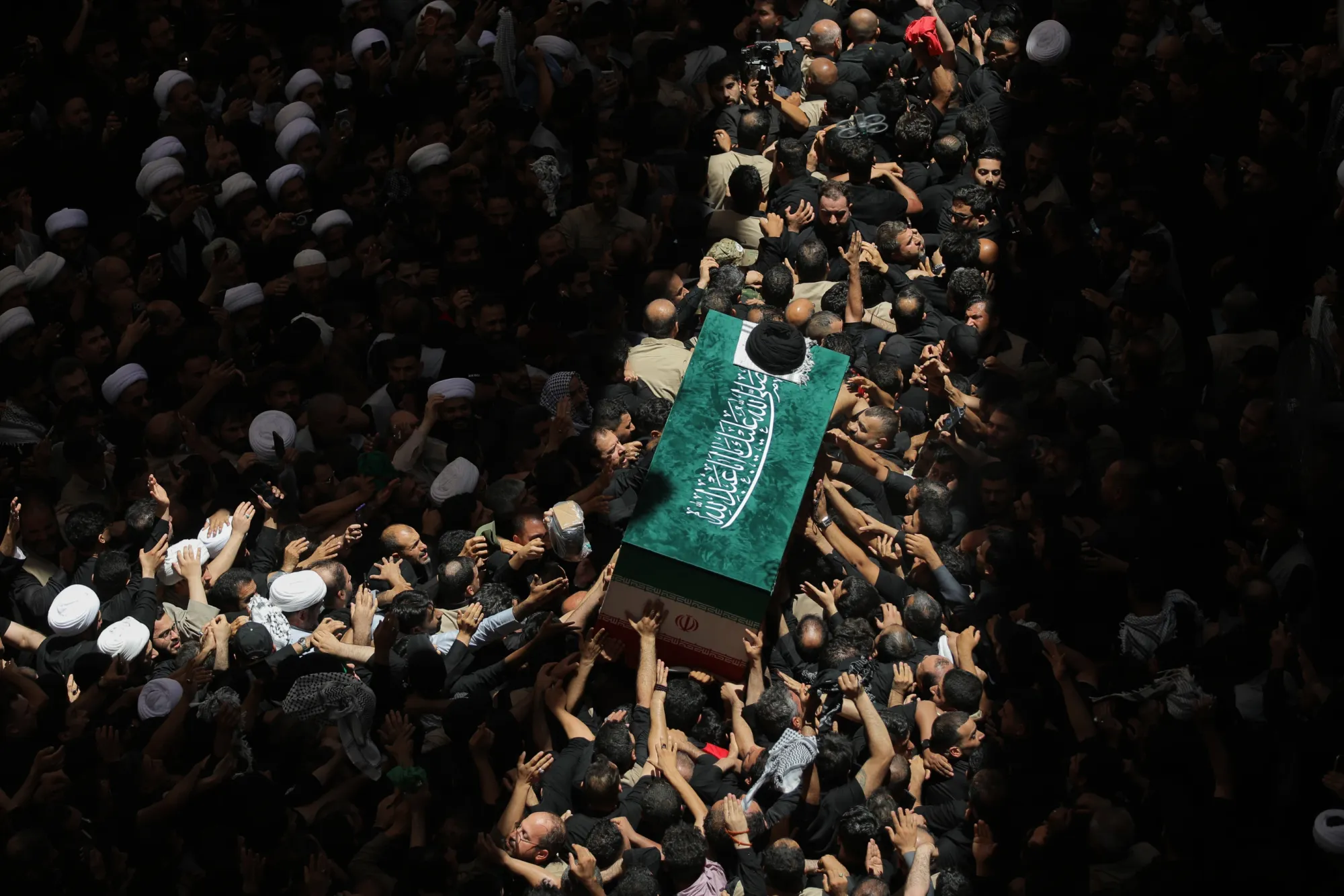
So did he do it? Did he try? The proof is in Iran's defeat of the Great Satan (we'll get to that also) in the Ramadan War of 2026, and the millions that came out for his funeral, and pledged to carry out Khamenei's vision, the Prophet's mission, and God's mission, with their lives. As his son and successor as leader of the revolution, Sayyed Mojtaba Khamenei said, "Peace be upon the Imam whose life-giving call to rise became a mighty and resounding echo of the Prophet’s mission, extending into the farthest depths of history, and through whose influence the Islamic Revolution of Iran came into being."
As Khamenei the Elder said, from the past, "You must always try to draw a lesson from history! Do not content yourself with stories and tales from the past. See instead what message history has for us today." When I (personally, ignorantly) read the Quran or Khamenei, I swear to God, it sounds like they're talking about the present moment. As Khamenei said (citing Ali), "No one sits down with this Qur'an save that he rises with an increase or a decrease; an increase in guidance or a decrease in blindness."
Hence I feel like Khamenei is talking about the brave city of Gaza, today, and the vilest specimens of humanity, the Jewish supremacists among White supremacists, when he said,
The Umayyads always made sure to appoint the vilest, cruellest, and most obedient of their servants to govern the city in order to deal with these elements... Because they could not bend these people to their will, they destroyed the land which made them instead.
And it feels like he's talking about the Al Aqsa Flood—the rise of rebellion and the scum it exposed across the White Empire—when he said,
God begins by saying 'He sends down water from the sky whereat the valleys are flooded to [the extent of] their capacity', whether they are big or small, 'and the flood carries along a swelling scum'. So God says: 'As for the scum, it leaves as dross, and that which profits the people remains in the earth.'.. 'That is how God draws comparisons' for you: He wants to show you how truth endures.
The mission of the prophets is truth. The uprising of the prophets are truth. The falsehoods that stand against the prophets vanish. They fade away. They collapse. They are the scum. The dross. The foam on the water. When you examine them, you see that they are really nothing.
I know the news today contains a lot of scum—what Donald Trump said yesterday, when the White media says about it, the half-hearted condemnations from White institutions all around—but what will be left, when history is written down? As Khamenei said, "What is ten, twenty, fifty or even a hundred years compared to all human history? It is but a minute, a fleeting moment, and nothing more."
Khamenei's View Of History
If you look at the Muslim world—indeed, the world—under ongoing colonialism, it certainly looks like the bad guys won. As Khamenei said, "This is how many Muslims see the world today: They think having faith means to take a beating! To be a Muslim, to be a believer, to be striving in the way of God, means suffering, means persecution, means oppression. The Qur'an wants to say the opposite is true—that from the moment religion came into being it was always moving forwards, it was always advancing, it was never going backwards."
This is what Khamenei repeats again and again, faith and action, faith and perseverance, faith and hope, not in the corrupt Barack Hussein Obama way but in the sense of Hussein of yore. Not as a suicidal urge but a drive towards life, towards humanity, towards shared humanity even while taking individual losses. He said, "This is a fundamental doctrine of Islam and an integral part of the Islamic worldview, namely that a happy future lies in store for the human race."
Of course, White Empire has occupied Islam's holiest sites, promoted Islam's unholiest minds, and this vision (if you only see within the Empire's proscribed timelines) seemed (from my unfortunately Western perspective) out of place and out of time. As Francis Fukuyama said in “The End of History?”
Modern liberalism itself was historically a consequence of the weakness of religiously-based societies which, failing to agree on the nature of the good life, could not provide even the minimal preconditions of peace and stability. In the contemporary world only Islam has offered a theocratic state as a political alternative to both liberalism and communism. But the doctrine has little appeal for non-Muslims, and it is hard to believe that the movement will take on any universal significance. Other less organized religious impulses have been successfully satisfied within the sphere of personal life that is permitted in liberal societies.
Fukuyama's wrong, but he's right. The White Empire really tried to promote a defanged version of Islam like their corruption of Christianity, where it was a 'permitted' personal belief which should have no impact on the shape of society. This is precisely the opposite of what Khamenei was building in the Islamic Republic of Iran, for reasons he outlined before it started, which is why the Empire tried to kill it time after time. Addressing Fukuyama directly from the past, Khamenei said,
If a thinker grew up in an outwardly Christian environment and knew nothing of the religion except corrupt practices like the selling of indulgences or the false forgiveness of sins, perhaps he had the right to form this opinion of religion. But you, who live a hundred, or eighty, or fifty years after him, at a time when Islam is more or less showing its true self, and producing the most wonderful and dignified manifestations of humanity the world has seen, you do not have the right to say the same thing about Islam as he does about Christianity. If this is what you mean to do, then this is being intellectually dishonest.
People today (including, if not especially, Marxists) will be like but Islam is a theocracy as if that is a bad thing, ignoring both the living example of Iran and what dead philosophers like Aristotle said, "there are more species of democracies than one," and how he spoke about "which is best suited for particular people." The Greek idea was that there are many Greek ideas, suited for many different city states, but the White Empire has corrupted this into one form of Democracy™ for the world, which they liberally corrupt and load into bombs. This is their pseudo-religion, their corruption of both Greek philosophy and Palestinian Christianity. As Khamenei said, "Pseudo-religions become a tool, a stick, and a weapon in the hands of the oppressor."
Khamenei and Iran rejected the corrupt Islam accepted and exported from the Gulf Apostates (especially Saudi Arabia), which was a personal (and punitive) form of Islam which offered no resistance to their occupation. As Khamenei said, "The kind of belief in God that has no effect on the global economic and social order belongs to the same category of belief as believing that a certain plot of land is barren or fertile—it has no use for us. It has no impact on the world. If a country's political leader believes in God but belief in God, for him, means nothing more than answering an abstract theoretical question, then what use is this?"
Looking at decades of Iran suffering under sanctions and war while the Gulf Apostates got richer and richer, however, you could say that submission to the Great Satan was very useful. As Khamenei said, "In a society where people live without a correct worldview, no matter which way they look, they see only this world and its trinkets. No matter which way they look, they see only enjoyments and opportunities for selfish pursuits." But what trinkets!
While the Gulf Apostates were flying fancy planes and buying football teams, it was a hard ask, what Khamenei asked, when he said, "Are you ready to turn your back on the side that offers you wealth, rank, prestige, comfort, influence, and power in exchange for your loyalty? If you are ready, then consider yourself fortunate: Had you been alive at the time of Ali, you would have been one of his supporters." Extending this to the historical Hussein, such followers would of course be dead, that's what resistance seems to have always cost. So is it worth it? Khamenei answered this, saying,
Now, some will say that, looking at history, wherever the truth is proclaimed, wherever its notes reach people's ears, it is ultimately fruitless and without result. The truth is suppressed... This is a logic that bullies want people to believe in and to make part of their creed. They want people to believe that there is no possibility for change, that none of their actions ultimately matter, and that nothing they do will produce any positive or lasting results. This is precisely what the tyrants want.
As he said about the consequences of this, "I must remind myself that it is this fear what causes people to lose this world and the next. It is fear of poverty that causes people not to spend for God, it is fear of persecution or harm that causes people to stay quiet when all matter of crimes, injustices and humiliations are being heaped upon them. The fear that they might not be able to live another day or two in this world! And what kind of life is this, to be lived in fear? Fear of losing this lowly life for which there is no guarantee that it will last more than another day or two!"
The Shia Scale Of The Task
This is the difficulty of Khamenei's task, not that he was fighting the White Empire, itself formidable, or 'Israel', itself cunningly evil, but that he was fighting for the very soul of Islam. Indeed, when he died, Iran was the only (fully) free state left standing in the region (shout-out Yemen, Lebanon, and Palestine)! The Empire talks up a Sunni/Shia split and tries to exacerbate it, but that's not quite it. Hamas is, of course Sunni, and on the side of the Resistance. But it's not not it. I won't weigh in on this, but this is what Khamenei said,
Here is a fundamental difference between Shia and Sunni thought. We say that 'those vested with authority' are those who meet the God-given criteria for leadership. On the other hand, they do not consider this a necessary condition. I cannot say I have thoroughly researched the contents of their works of jurisprudence. However, what they frequently say in their public statements is that anyone who occupies a position of power and authority should be respected and recognised as legitimate.
The split goes back centuries and it comes down to resistance, ie the path of Hussein (who died rather than submit to what he considered an illegitimate ruler or not). That is to say, the Islamic Revolution wasn't just an Islamic Revolution but a Shia one. As Khamenei the Younger said, recently, "It was a revolution that was Husseini at its very foundation, built and nurtured upon Hussein’s slogan and way. Iran’s martyred leader also grew according to this same way. He was Husseini; he thought in a Husseini manner, acted in a Husseini manner, struggled and resisted in a Husseini manner, lived in a Husseini manner, and offered his blood in the path of Hussein’s school, attaining martyrdom."
What Khamenei the Elder said, in a way commenting on his own funeral,
When you sit in the majilis of Imam Husayn and shed tears, you are doing something good—it is good and proper to cry for him! However, you are doing something bad indeed if you believe that shedding these tears is enough to qualify for wilayah. The Penitents (Tawwabin) gathered at the grave of Husayn ibn Ali and spent one, two, or three days weeping for him. But what was the outcome of their weeping? The outcome was they made a pact of blood and self-sacrifice. They said: We are going to the battlefield and we are never going to turn back. We pledge not to return alive! This is crying for Husayn—and no one opposes this!
And, indeed, this is what the people of Iran, en masse, cried out for. They waved the red flag of revenge, they called for Trump's head. They are not crying against tyranny, they are trying to do something about it. This is precisely the lesson Khamenei wanted to impart, and he did.
Thus he seems to comment on his own death from the past, saying,
Now I want you to imagine that each of these teachers, after spending a year teaching this class of students, are killed by some of their own students! Each teacher comes and delivers his lesson and dies—but has he failed? Think about this carefully. Has that teacher failed? What was that teacher's goal? Didn't he want to raise his students up to the heights of learning and enlightenment? If this is the case, then the teacher did not die in failure. True, he may not see the fruits of his labours. But did he fail in his mission? Certainly not. As a teacher, his goal was to ensure that his students graduated to the next year of their studies and, with struggle and perseverance, they did.
Khamenei was killed, not by his students, but directly by the tyrant and he lives, he lives, most importantly in the impetus he has given to millions of lives, which was the point all along. As he said about the prophetic path he followed,
Why did the Prophet come? 'I was sent to complete the best of morals'—the Prophet came to make human beings; he came to nurture something called humanity in people. Through what means or by what way did the Prophet set about making human beings? How did the Prophet promote humanity? Did he establish a philosophical school of thought? Did he build a temple or place of worship? No! In order to produce human beings, he made a human-making factory! The Prophet was willing to wait ten or twenty years to succeed, but he did not want to produce just one or two, or even twenty human beings, he wanted to create a fully automated factory that would continuously produce perfect human beings...
What exactly is a human-making factory? It is an Islamic society and system of government... Islamic society is a society which is ruled by God, and whose laws are the laws of God. God sits at the top of the pyramid, and beneath God is all of humanity and the humans.
You can talk (and I do talk) about Iran's superiority in military production, in scientific production, in intellectual production but these are all a side-effects of its spiritual production. Indeed, talking about the corruption of the caliphates that mirrors the defilement of Islamic holy sites by Whites today, Khamenei said (I will reproduce this at length because it's fascinating),
When we study the time of the Umayyads and the Abbasids, we see that the Islamic world was full of energy, we see the amount of knowledge and learning that was taking place in Islamic society; what great physicians there were, what great translators! ... If we want to be honest, did all of that activity ultimately end up benefitting humanity and Islamic society? What does Islamic society have of this heritage ten centuries later? And what has it lost? Is it for any other reason than the fact that all of these efforts, even if they were valuable for the benefit of all humanity, ultimately took place under the auspices of taghut [Satan].
As the poet Hafiz says: "I shall never grasp the jewel of Solomon, Lest one day it falls into the hands of Ahriman.
Even from the perspective of learning, literature, and the issues in which the world takes pride today, even if this had delayed work by a hundred years, it would have been of more benefit to the human race. This is because humanity would have grown, Islam would have flourished, and human energy and potential would be channelled into the correct path. On the other hand, under the Abbasids, even through great strides were being made in science, what about individual morals and societal ethics? Is it ok to leave this so weak so that class divisions remain an entrenched component of society?
It is exactly like the disgraceful and corrupt civilizations of the world today. The world powers boast of their scientific discoveries, they boast of their wonderous inventions, they boast about every medicine, every formula, every undertaking. This is from the perspective of science. However, from the perspective of humanity and ethics, nothing has changed from a thousand years ago. Today we see fabulous wealth side by side with terribly hunger and poverty... Great scientific advancements are taking place, but there is no concern for the values of humanity or virtue; huge class differences remain, and at the same time as one part of the world is starving, the other part eats itself to death.
Capitalism and the White Empire has this fetishization of progress, this idea that all the colonialism and destruction that happened was worth it because cell-phones and medicine and so on, and Khamenei stands athwart this history saying stop. You may be going fast, but you're going in the wrong direction. He said it doesn't matter how nice the vehicle is, or how nice and polite the people inside it are, if it's going the wrong direction, it's going wrong. As he said, "If the car is taking you in the opposite direction to Nishapur, even if all the passengers in this car are polite, considerate, and respectful, it is still not going to get you to Nishapur—it's going to take you to Quchan! Therefore, when there is a society organised under the wilayah of taghut, human beings will not reach their destination. They cannot be Muslims."
This is important and not coincidental. You cannot separate Islam and the Islamic Revolution any more than you can separate spokes from the center of a wheel. Khamenei spoke about turning personal faith into action, turning that into collective action and then governance, following the guidance of God and his prophets under a rightly guided Imam and God was at the center of it all. And who was the Imam? It was him, after all. That's the spoiler alert at the end of this book, which the people listening to it under the tyranny of the Shah couldn't quite know, that it was the preacher Sayyed Ali Khamenei who was the 'hidden' Imam (not that one) that would take this all forward.
And what did he want? What did Khamenei really want? Not a personal awakening, not to be right, not even to finish the task, but to awaken many people, to guide many to the right path, and to entrust them with the task after he was gone. And he did it, by God, he did it. In this way, Imam Khamenei changed the world, and forever changed the way it turns.
I invite you to read more, the book is Islamic Beliefs: Reclaiming The Narrative. I cannot do justice to what he said. This text is not available as eBook, so I've typed out the following highlights for my reference, which you're welcome to:
"The human being has two powerful wings to carry them through life: One is steadfastness (sabr) and the other is relying on God (tawakkul). Any nation which has these two wings will fly beyond the reach of their enemies."
"A faith that remains only in the heart will wither and die... Faith alone, faith without duty, faith without any sense of responsibility, is of no use in this world and of no use in the Hereafter."
"As the Arabic proverb read: 'A lion amongst friends and an ostrich amongst enemies' So, on little issues, you are a lion but when it comes to serious ones, you are an ostrich. All your courage is gone! This proverb means that when it comes to your own, you are a lion, but when you are facing enemies with swords, you become an ostrich. How does an ostrich fight? Does it have claws and teeth?"
"When we speak of justice, of observing fairness in society, of protecting the oppressed and dispossessed, of treating both friends and strangers equally—these are all religious teachings, these are all teachings of Islam—of raising the level of people's thinking, which was the goal of divine prophethood, when religion meant observing these things."
"Whatever opposes the human intellect, religion opposes it. Whatever stands against people's vision, thinking and comprehension, religion stands against it. Anything which, in any way, shape or form, impairs the human ability to comprehend, to see, to thing... religion will not leave it standing. This is the true religion. The religion which they call 'the opiate of the masses' is something else entirely. We find no trace of that religion in the Qur'an. We find no trace of that religion in the practice of our Prophet or of our Imams. Islam fights against ignorance. Islam fights against that kind of religion."
"This is how many Muslims see the world today: They think having faith means to take a beating! To be a Muslim, to be a believer, to be striving in the way of God, means suffering, means persecution, means oppression. The Qur'an wants to say the opposite is true—that from the moment religion came into being it was always moving forwards, it was always advancing, it was never going backwards."
"Faith must come from understanding, not blind imitation. Faith must be combined with a sense of moral duty and the performance of right actions."
"As Attar said, 'Set out on the journey and do not ask, The journey will tell you how to go!'"
"Being tranquil does not mean ignoring what the enemy is doing. It means not being anxious, not being confused, knowing that the future is clear and that your side will triumph and, for this reason, not being afraid."
"Beyond this realm of appearance that you and I see, beyond whatever the most acute vision can perceive, and beyond whatever the most precise empirical science can apprehend—beyond all the phenomena that we can sense and touch—lies a reality that is higher than any other, more sublime than any other, and nobler and mightier than any other, and through whose power all the phenomena of the world came to be. To this higher being, we give a name. We call it 'God'. We call it 'Allah', Therefore, the world is a reality which, at the very core of its own being, does not exist independently or in of its own self. It did not bring itself into being. It did not come into existence spontaneously. On the contrary, this panoply of phenomena, about which we learn more and more with each passing day as they disclose more and more about themselves to us, was created by this Higher Power. It is this power that created the tumult at the heart of the atom and has created many millions of galaxies, or which we have only discovered a few."
"A person who sees his own desires as the most important thing in his life is said to have taken them as a god. Someone who allows the affairs of his life to be directed by a vain and tyrannical person is said to have taken Satan as his god."
"No one has the right to place his head beneath the foot of another, nor does anyone have the right to place his foot on the neck of another."
"If you ask them: 'What is religion?' They will name some practices and say: 'This is religion.' They will say: Religion is a drug. Religion is a tool of the oppressor. Religion cannot help the downtrodden. So leave it! Of course, when a person is confronted by this logic, the correct response is to say: 'You're right! If you find a religion that helps the oppressor, that supports the tyrant, that never gives aid to the oppressed, that never helps the downtrodden, that whether now or in the future does not alleviate an ounce of human suffering—then, on our behalf, if you find such a religion, no matter where it is, reject it. Do not accept such a religion for even a moment!"
"So, O materialist! O you who say that religion cannot possibly govern human societies! I ask you: Which religion? The religion of Islam? The true Islam? The revelation of Muhammad? The way of Ali? You believe that these are incapable of the governance of human affairs? OK, then prove it. Where is the evidence for this? When Islam came and erased division, when Islam rejected class divisions, when Islam established an equitable division of wealth amongst the people, when it improved people's standard of living and provided them with opportunities for growth, when it took the reins of power out of the hands of tyrants and handed them to the just divine law, when it raised up the oppressed, the downtrodden, the slaves, when it took people who were willing to commit the worst outrages for vanity or wealth... when Islam took this abased human and ennobled him, dignified him, and bestowed upon him the best human and moral virtues—all of this, under the auspices of a single wise and just order. So where is your proof?"
"The prophet did not just educate individuals. He did not take people one by one and sit them down and utter slogans to them until they became good, until they became human—this is not how he did it. He was not a preacher—he did not just sit and preach to people. This wouldn't have had any effect. On the contrary, he created a social order."
"If a thinker grew up in an outwardly Christian environment and knew nothing of the religion except corrupt practices like the selling of indulgences or the false forgiveness of sins, perhaps he had the right to form this opinion of religion. But you, who live a hundred, or eighty, or fifty years after him, at a time when Islam is more or less showing its true self, and producing the most wonderful and dignified manifestations of humanity the world has seen, you do not have the right to say the same thing about Islam as he does about Christianity. If this is what you mean to do, then this is being intellectually dishonest."
"Pseudo-religions become a tool, a stick, and a weapon in the hands of the oppressor."
"The kind of belief in God that has no effect on the global economic and social order belongs to the same category of belief as believing that a certain plot of land is barren or fertile—it has no use for us. It has no impact on the world. If a country's political leader believes in God but belief in God, for him, means nothing more than answering an abstract theoretical question, then what use is this?"
"A tradition says: 'All wealth belongs to God. He has entrusted it to people.' This is the logical corollary of tawhid. If this is the kind of divine unity [tawhid] you believe in, then all sorts of class difference and divisions in society would be utterly meaningless to you. A society with upper and lower classes, with haves and have-nots is not a truly monotheistic society. Divine unity tells us: 'All of you are from Adam and Adam is from dust.'"
"When you covertly play with people's thoughts and emotions—when you manipulate their free will and decisions, you have enslaved them without them even knowing that they are slaves."
"In an Islamic society, people serve God rather than the powerful."
"In a society where people live without a correct worldview, no matter which way they look, they see only this world and its trinkets. No matter which way they look, they see only enjoyments and opportunities for selfish pursuits."
"The wrongdoer who serves the tyrants—who is himself a tyrant by extension—also imagines that he has power, because he is connected to someone with even more power. He is like the fox that has tied its tail to that of a camel."
"Does divine unity place responsibilities not only on the individual believer but on the society of believers as a whole—responsibilities which address the most important, universal and fundamental issues of any society? Like what? Like government. Like economics. Like international relations. Like relations between members of the society—the fundamental principles that govern the life of any human society! We believe that the responsibilities created by tawhid and placed upon the shoulders of the believer are of this kind—that these responsibilities extend to every aspect of society and deal with its most fundamental issues."
"'Satan' denotes any baleful power that exist outside of the human being. An evil power, but only one that is outside of a person's own existence... Satan refers to anything that is outside of your own being that tries to lead you away from perfection, to prompt you to commit evil, to kindle wrongdoing."
"[As Imam al-Baqir said, in a hadith where God is meant to be the speaker] I will surely punish every flock in Islam who believed in the authority of any tyrannical leader who was not appointed by God, even if this flock were righteous and pious in their personal conduct."
"Refusing to worship false gods, whether they dress themselves in the cloak of faith—like the rabbis and priests—or in the robes of worldly power—like the tyrants and princes— this is the meaning of tawhid."
"The result of a caste-based society and a capitalist society is virtually the same: A small ground enjoys limitless resources, while the majority has virtually nothing."
"When the Jews and Christians claim that God has chosen them to the exclusion of all other, Islam responds by saying that they are mistaken."
"What is ten, twenty, fifty or even a hundred years compared to all human history? It is but a minute, a fleeting moment, and nothing more."
"I must remind myself that it is this fear what causes people to lose this world and the next. It is fear of poverty that causes people not to spend for God, it is fear of persecution or harm that causes people to stay quiet when all matter of crimes, injustices and humiliations are being heaped upon them. The fear that they might not be able to live another day or two in this world! And what kind of life is this, to be lived in fear? Fear of losing this lowly life for which there is no guarantee that it will last more than another day or two!"
"Religion has no conflict with human reason or learning and never will. What religion says is understood by a sound intellect."
"Why did God send religion? To guide the intellect, to take it by the hand. The intellect is there, but when the intellect is best by desire, it cannot judge impartially. The intellect is there, but when ambition is by its side, it cannot see clearly. When some personal goal is next to it, it cannot understand properly. Religion was sent to defend the intellect from desires, ambitions, and fears."
"Whatever is in agreement with the innate nature of the cosmos, whatever is conducive to the natural order of the universe, this is what we call 'truth'."
"If he had not changed, he could not change the world. This is an important lesson for those who would follow the Prophet: As long as they have not changed, they cannot change the world around themselves."
"True tawhid means the power and governance of God. True tawhid means that everything—whether the law, traditions, treaties, manners, culture—must be inspired by God."
"This is what the doctrine of holy struggle (jihad) was promulgated: Because the ruling class, the ones against whom the revolution is directed and those who stand to lose the most in the even of its success, are not ready to let it happen."
"It is the human being that discovers uranium and, instead of using it to treat a thousand illnesses, turns it into a bomb with the capacity to kill millions. Uranium does not make itself into a bomb; it merely follows its natural course. It is not LSD that, instead of being a medicine to cure sickness, is instead made into a drug to intoxicate youngsters. It is not the fault of LSD how it is used. It is not the fault of the matter. Rather, it is the fault of the human beings that choose to use it in this way."
"God always desires to show favour to those who are based, to the underclass, to the downtrodden and oppressed."
"This is the Prophet's greatest miracle. To make a man who puts aside all ego and selfishness—which is the axis around which most men's lives turn—and is willing to sacrifice everything for the cause of truth."
"Materialist philosophies say that we should develop the world, eliminate poverty, uproot ignorance and build a better society—a human society, a society in which there are no class divisions, in which there is no division or exploitation. Great! But once we have it, what are human beings supposed to do in it? Materialist philosophies do not have an answer to this."
"Let's go to that monastery and live as monks. We will spend all our time purifying ourselves and becoming better people, and we will save ourselves. Then, if someone comes to us and is receptive, we can teach him how to do the same, and we'll make him a better person too! This attitude is often used as an excuse for being lazy, quiescent, saving one's own skin and choosing the path of least resistance."
"The prophets had two major goals. Their fundamental goal was to make people into human beings, to save people from their vices and to adorn them with virtues. In short, to make human beings humane. That was their highest goal. However, there was another goal which was a preliminary to achieving this one, namely, to create a tawhid-oriented society that is government by a godly system of government and ruled by God's laws."
"God also sent 'the Balance' (al-mizān)—what is the Balance? ... The Balance is the Imam because the Imam is the one who separates truth from falsehood in society."
"Do you think the devils, wolves and thieves will leave this just society standing? That is why God sent iron—so that people could defend their most dearly held values."
"The religion of Islam believes that faith must be based on reason and understanding and does not accept unthinking followers."
"If there were not this institution of scholarship and learning in Shia Islam, we would be in an even more dire situation than we find ourselves now."
"No nation is sanctified unless the weak can claim their rights without stuttering."
"The Commander of the Faithful (a) was expressing this viewpoint when he said: 'I have never seen copious wealth without there being unpaid dues beside it.' If wealth was divided equally amongst people, there would be no one as wealthy as Rockefeller!"
"When you have a usurious system like this in society, it means that everyone in society is paying interest, and a small group are amassing wealth. In other words, all the business people—in fact, the whole economy—is structured for the benefit of usurious institutions and the people who own them. Now, if you come to a society where being wealthy is revered above all other things, where usury is considered noble, and where someone is making money without needing to produce anything, and a prophet or reformer comes and says that usury is forbidden, it is clear that someone who benefits from usury and charging interest is going to oppose that prophet!"
"We realise that the Imam [Zayn al-Abidin] was explaining something that we have only just been able to understand today with the gift of hindsight. He says: 'Know that the least thing you hid and the lightest burden you carry is that you knew the terror of the oppressor but smoothed for him the way of deviation through your proximity to him when you approached and your responsiveness to him when you were summoned!"
"When we look into the Qur'an, we are told that in every nation that a Prophet is sent to, it is the well-off who are the first to oppose the Prophet."
"They said, "Kill the sons of the faithful who are with him." They decided to kill the sons of anyone who believed in the new ideas propounded by Moses. They killed these sons so that they would not grow up to threaten their position in the future. Kill their sons to break their spirit and deprive them of hope. 'And spare their women.' Why do they say to spare their women? There is a reason for this. This is so they will have to intermarry with other peoples and their descendants will no longer be fully Israelite, to promote indecency and to use them to satisfy their own desires, to humiliate them. There are many reasons why Pharaoh and his supporters did this."
"Now I want you to imagine that each of these teachers, after spending a year teaching this class of students, are killed by some of their own students! Each teacher comes and delivers his lesson and dies—but has he failed? Think about this carefully. Has that teacher failed? What was that teacher's goal? Didn't he want to raise his students up to the heights of learning and enlightenment? If this is the case, then the teacher did not die in failure. True, he may not see the fruits of his labours. But did he fail in his mission? Certainly not. As a teacher, his goal was to ensure that his students graduated to the next year of their studies and, with struggle and perseverance, they did.
"This is a fundamental doctrine of Islam and an integral part of the Islamic worldview, namely that a happy future lies in store for the human race."
"Now, some will say that, looking at history, wherever the truth is proclaimed, wherever its notes reach people's ears, it is ultimately fruitless and without result. The truth is suppressed... This is a logic that bullies want people to believe in and to make part of their creed. They want people to believe that there is no possibility for change, that none of their actions ultimately matter, and that nothing they do will produce any positive or lasting results. This is precisely what the tyrants want."
"The pages of the world's newspapers are filled with the bluffs of our national leaders for this very reason. Someone who has only a few hours, or at most days, left before his government is removed from power and he is reduced (if he is lucky) to the status of an ordinary citizen, will bluff to the very end."
"al-Mansur spread the rumour that he had an enchanted mirror that showed him all of Abd Alla and Ibrahim's movements, and whose houses they were sheltering in and who was joining them. Funnily enough, this story of an enchanted mirror is virtually the same as the one told be kings like Jamshid almost two thousand years before in order to frighten their enemies into believing that they couldn't possibly do anything without these kings knowing it."
"Without any supernatural acts, there are two practical conditions that must be met in order for Islam, the Qur'an, religion, and Qur'anic ideals to be realised. What are these two conditions? One of these conditions is faith (iman), namely belief on the basis of understanding, accompanied by a sense of moral duty and practical action. This is the first condition. The second condition is perseverance (sabr). It means to resist, not to withdraw, to be able to take action at the critical juncture."
"The general rule is that wherever the prophets found followers of sufficient faith and perseverance, they were successful, but wherever they did not find followers with these qualities, they were not."
"God beings by saying 'He sends down water from the sky whereat the valleys are flooded to [the extent of] their capacity', whether they are big or small, 'and the flood carries along a swelling scum'. The floodwaters in the valleys carry a froth on their surface. When you stand next to a flooded river, what you see first is not the water, but the scum and the froth that floats on top of it. The water is underneath... So God says: 'As for the scum, it leaves as dross, and that which profits the people remains in the earth.'.. 'That is how God draws comparisons' for you: He wants to show you how truth endures. The mission of the prophets is truth. The uprising of the prophets are truth. The falsehoods that stand against the prophets vanish. They fade away. They collapse. They are the scum. The dross. The foam on the water. When you examine them, you see that they are really nothing."
"We looked at the succession of prophets as a whole from the first to the last, and we saw that these teachers of humanity were indeed successful in their overall mission.. Their teacher in the first year only took them a little of the way and he did not see them reach their goal, as he died before this came to pass. However, do we judge whether or not he succeeded as a teacher? Just because he did not stay with the children to the end of their studies, does this mean that he failed them? Of course not! He did his task. He discharged his duty. Then he handed them over to the next teacher to perform his share of the responsibilities."
"It seems as though the general experience of history is this: All movements under the banner of truth and justice inevitably fall prey to falsehood and tyranny. Yes, some people who don't comprehend the logic of the Qur'an imagine this to be the case. This notion is a pleasant balm for the tyrants and oppressors of history. They want people to believe this and it is clear that they play a role in promoting this idea. However, it is completely false. If Zayd ibn Ali was martyred and his movement broken, it does not mean that truth is destined to be brought down by falsehood. On the contrary, it shows that even though the truth is the truth, upholding it requires struggle and effort."
"They had become men who sought ease, who sought comfort, who preferred survival to struggle. They had strayed far from the divine teachings."
"An unjust society, an unjust government, an unjust civilization is one in which structures of oppression are employed, where class differences are created, where exploitation takes place, where one person uses another. This is the 'wrongdoing village' of which the Qur'an speaks. This wrongdoing village refers to an unjust social order, which is used by tyrants for their own ends. God exclaims: How many of these We have smashed! 'How many a town We have smashed that had been wrongdoing, and We brought forth another people after it.' Then God brought another people, another group, another class to rule."
"'So when they sighted Our punishment', the misery of the wrongdoers when they saw God's wrath, 'behold, they ran away from it.' When they sensed God's wrath and anger, they fled. God's punishment either meant when they saw a miraculous punishment descending from the heavens, or when they saw the prophets and the faithful with them gain authority over them and raise the sword of God's justice above their heads, 'behold, they ran away from it.' No sooner had a just society and civilization been established than they fled elsewhere. Go back to your palaces in which you live in luxury, go back to your societies and your cities in which you lorded your status over others—where will you go?
"Why must the oppressors fall and the oppressed rise? Why must the prophetic call always triumph over its opponents? The reason is as follows: 'We did not create the sky and the earth and whatever is between them for play."
"The responsibility or duty that a believer in prophethood undertakes refers to his or her following the path of the Prophet and accepting the responsibility to convey the Prophet's message. It is very easy to say these words—it is much less easy to live up to them."
"Yes, it is necessary to believe in the Prophet, but believing in the Prophet also leads to the existence of certain moral duties. If these duties are fulfilled, then a person's belief is correct to the extent that he fulfils these duties."
"When I look at our own time today, I ask whether this goal that the prophet wanted to reach—has it been fully achieved? That edifice that the Prophet wanted to build, has it been fully constructed? If I see that the answer to my question is 'no', meaning that the Prophet's burden has been left by the wayside, his mission has not been fulfilled, and that edifice has not been completed, then I should do my utmost to continue his work and achieve his goals. I should try to lift up this burden. And if my limbs are too weak, if I lack the strength, then I should do as much as I can and find ten other people to help me carry this load. I should find more people still to help me erect this edifice. And if I cannot finish this edifice in my lifetime, can I not at least add another row of bricks? Can I not ready its foundations? Can I not make preparations for other to do the work? If someone says that they cannot do anything at all, this is a lie."
"The mission of prophethood is to reshape the world according to the teachings of Islam—this is what the prophets came to do."
"The prophets are agents of division! In the sense that the prophets split society into two camps. Pay careful attention to this if you want to repeat it to someone... [An] example: A caravan is heading towards an ambush by bandits, or it is heading towards a crumbling precipice. A prophet comes and warns the caravan to turn back; some of the caravan ignore him and press on to their doom, while others listen to him, turn back, and are saved. In this way, two groups are created—division!"
"Now, between these two sides, there is a person. He listens to the Prophet and sees that what he is saying is right. As much as he listens, he sees that what the Prophet says is good. On the other hand, he sees that if he joins the side of the Prophet, then he has no choice but to oppose the other side. He does not want to join the other side, because he sees they are heading towards Hell, but neither does he want to join the side of the Prophet because he can see following the Prophet is hard work! What does he do? He goes between the two sides and finds a safe quiet spot in which to pitch his tent. What sort of person is this? You tell me! This person is not with the Prophet. Anyone who is not with the Prophet is against the Prophet. Anyone who is not with Ali is against Ali. Anyone who is not with the truth is against the truth. This is what the Qur'an tells us. However, Imam Ali makes this very clear for us when he says: 'The one who stays silent is the brother of the one who approves.'"
"If you are not helping the truth, even if you are not fighting against it, your inaction still places you on the side of falsehood... As a poet [Nayyer-i Tabrizi] once said: 'Said he: 'O people whoever does not follow our path, Should get up and leave our Karbala!'"
"Are you ready to turn your back on the side that offers you wealth, rank, prestige, comfort, influence, and power in exchange for your loyalty? If you are ready, then consider yourself fortunate: Had you been alive at the time of Ali, you would have been one of his supporters."
"As a tradition says: 'It is when a man is tested that he is ennobled or abased' and another reads: 'It is in the vicissitudes of life that a man's substance is known.'"
"'As for the faithless, they are allies of one another.' Even if they are in two different camps, they are united in their hostility towards you. 'Unless you do the same, there will be strife in the land and great corruption.' Perhaps what this verse means is that if you are not united, if you do not stand together, if you do not present a united front to the enemies of God, and if you do not realise that whoever is standing between the two sides might as well be on the side of the enemy, then there will be great tribulation and corruption in the land."
"Why did the Prophet come? 'I was sent to complete the best of morals'—the Prophet came to make human beings; he came to nurture something called humanity in people. Through what means or by what way did the Prophet set about making human beings? How did the Prophet promote humanity? Did he establish a philosophical school of thought? Did he build a temple or place of worship? No! In order to produce human beings, he made a human-making factory! The Prophet was willing to wait ten or twenty years to succeed, but he did not want to produce just one or two, or even twenty human beings, he wanted to create a fully automated factory that would continuously produce perfect human beings."
"What exactly is a human-making factory? It is an Islamic society and system of government... Islamic society is a society which is ruled by God, and whose laws are the laws of God. God sits at the top of the pyramid, and beneath God is all of humanity and the humans."
"In non-Islamic and non-religious societies, even the people who want to be good cannot be good."
"Prophets come in order to make something. When they have made it, it is like a human factory; it does not make Muslims by ones, by tens, or even by hundreds, it makes them in generations."
"This verse gives a clear response: 'Don't make a mistake! Their hearts will not be softened towards you! Those who believe the opposite to you, those for whom your beliefs and your faith are detrimental to their interests, those who want to destroy your religion and your faith, they will never be your friend!' O Hatib, you fool! Do not imagine that just because you help them now, tomorrow they will help you—no, by God! The more you help them, the more power they gain over you. The more you help them, the better they can oppress you and do you wrong."
"The Islamic world must try to organise its relations with the non-Islamic world and the world that is not part of this Ummah so that it does not even fractionally fall under the latter's control, or even fractionally fall under the influence of its ideas."
"This story dates to the time of Imam al-Baqir or Imam as-Sadiq, when the Muslim world typically used Roman coinage. The Romans threatened to cut-off this supply of coins, and the Muslims were left helpless. The Imam advised the Caliph to strike his own coins."
"The Islamic society and the Muslim Ummah do not have the right to form relations with the non-Islamic world except from a position of strength and superiority. In other words, the connection between the Muslim Ummah and a non-Muslim nation should never be based on exploitation."
"There must be a point in the fabric of that society in which those powers are concentrated, a point to which all of these powers are connected, from which all of these powers take inspiration and direction."
"For example, look at carpet weavers. If there wasn't someone supervising and planning how they should weave, how will this carpet turn out? One side with be Turkoman and the other will be Kurdish!"
"[As Ali said] No one sits down with this Qur'an save that he rises with an increase or a decrease; an increase in guidance or a decrease in blindness."
"Do not look at how their blocs are opposed to one another, because insofar as they are against you, they are the same."
"'Yet you see those in whose hearts is a sickness rushing to them'. They rush to join the side of the enemies of the faith; they don't just go over to the other side, they rush over to them; they are not content being beside them, they want to be amongst them! And if you ask them: "Why are you working so closely with the enemies of the religion? Those who you know are the enemies of your faith? Never mind not opposing them, why are you they friend?" If you ask them this question, they respond, 'saying "We fear lest a turn of fortune should visit us'". They say, if we do not become their friends, we are worried that some harm will come to us... (see how familiar these words are even today?)."
"What is God's response to these people? 'Maybe God will bring about a victory' for the faithful 'or a command from Him'—or something will happen by His will that is to their benefit—'and then they will be regretful for what they kept secret in their hearts'. Then they will say: 'What a terrible mistake we made! If we had known that the faithful would triumph and become strong like this, we would never have cooperated with the enemies of faith and humiliated ourselves like this!'"
"'Are these really the same people who made these promises?' 'Are these the same people who said they were with you?' God says: 'Their works have failed, and they have become losers.'"
"The issue is one of dependency—Muslims should not be dependent upon or follow non-Muslim powers. They must stand on their own two feet."
"When you sit in the majilis of Imam Husayn and shed tears, you are doing something good—it is good and proper to cry for him! However, you are doing something bad indeed if you believe that shedding these tears is enough to qualify for wilayah."
"The Penitents (Tawwabin) gathered at the grave of Husayn ibn Ali and spent one, two, or three days weeping for him. But what was the outcome of their weeping? The outcome was they made a pact of blood and self-sacrifice. They said: We are going to the battlefield and we are never going to turn back. We pledge not to return alive! This is crying for Husayn—and no one opposes this!"
"Find the wali, recognise God's wali, that person who is the rightful wali of the Islamic society, and identify him. Once you have identified him, then your thought, your practice, and your spirituality must be guided by him; connect yourself to him, follow him. If his struggle is your struggle, if his fight is your fight, if his friend is your friend, if his enemy is your enemy, if his side is your side, then you have wilayah. Do you see?"
"So, when a society has wilayah, what happens then? To put it in a single sentence: This society becomes like a dead person who has been brought back to life."
"A society without wilayah has potential, but it is unrealised, wasted, fading away, or—worse still—being used to suppress human flourishing: It has a brain, and the brain is thinking, but its thoughts are of corruption, of murder, of destruction, of misery, of exploitation and tyranny."
"A society which prays—meaning a society in which all of its elements are mindful of God and remembers God—creates a wave."
"While the caliph was quite literally giving away land grants and living a life of opulence and excess, a descendant of Imam Hasan by the name of Yahya ibn Abd Allah Alawi was fighting against tyranny and oppression in the mountains of Tabaristan, and he and his family had only a single cloak between them."
"Islam does not predict a day in the future when there will be no need for a state or government in society—this is unlike some other schools of thought which foretell the advent of an ideal society, one of whose features will be the absence of any form of government or state apparatus. Islam does not accept such a view."
"Here is a fundamental difference between Shia and Sunni thought. We say that 'those vested with authority' are those who meet the God-given criteria for leadership. On the other hand, they do not consider this a necessary condition. I cannot say I have thoroughly researched the contents of their works of jurisprudence. However, what they frequently say in their public statements is that anyone who occupies a position of power and authority should be respected and recognised as legitimate."
"The word taghut does not refer to any one thing... Yes, it is the name of an idol, but not any specific idol. Sometimes that idol is your own self. Sometimes, that idol is your wealth. Sometimes, that idol is seeking an ordinary and comfortable life. Sometimes, that idol is your ambition. Sometimes, that idol is the person who takes you by the hand, closes your eyes, and takes you wherever he pleases. Sometimes, this idol is gold and silver, unliving metal. Sometimes, this idol is a human being, your nearest and dearest. Sometimes, it is the social order. Sometimes, it is the law... What is the relationship between taghut and Satan? Is there any relation between the two? Yes! Satan is the taghut, and the taghut is Satan."
"This Satan, whose story we know and who we curse almost every day of our lives—poor guy!—is just the first of the devils. He is not the only devil. In fact, he may not have even been the first, and he certainly was not the last!"
"If you submit to the wilayah of Satan, this means that Satan gains control over all the useful, creative and fruitful energies that are contained within your existence... Everything that is in your existence, all of your energy, your creativity, your agency, your brilliance, will fall into their grasp. And when all of your existence is in their grasp, it is easy for them to drive you down the same path that they chose, and take you to the same destination as they reached."
"If they have to sacrifice you for their own ends, they will sacrifice you without hesitation."
"The Umayyads always made sure to appoint the vilest, cruellest, and most obedient of their servants to govern the city in order to deal with these elements, [whether] by outright persecuting them, by spreading negative propaganda, or by presiding over the pauperisation of the city's people, in order to corrupt them and lead them astray. Why did they do these things? Because that resistance group were only found in this city [Kufah] and not in others. Because they wanted to smash the basis of this resistance and make use of this city for their own ends. Because they could not bend these people to their will, they destroyed the land which made them instead."
"You must always try to draw a lesson from history! Do not content yourself with stories and tales from the past. See instead what message history has for us today."
"Satan only has power over those who accept his wilayah, just like the authority of Hajjaj was only over those who sat and listened to his harsh speech."
"Satan makes promises to them about their future, but it is all lies; he inflicts far-fetched hopes upon them and, in the end, all he offers them is deceit and delusion."
"Can we not both be Muslims and under the wilayah of taghut? Can we not imagine a Muslim living under Satan's authority, while still serving the All-Merciful? ... There are many people there, so even if you want to turn back, you are carried along by the crowd. You want to be good, you want to live a good life, you want to live like a human being, you want to remain a Muslim and die a Muslim, but you cannot. In other words, the currents of society have caught you and are taking you with them—there is nothing you can do to resist... Not only can you not resist, worse still is the fact that sometimes you don't even realise what is happening."
"When we study the time of the Umayyads and the Abbasids, we see that the Islamic world was full of energy, we see the amount of knowledge and learning that was taking place in Islamic society; what great physicians there were, what great translators! ... If we want to be honest, did all of that activity ultimately end up benefitting humanity and Islamic society? What does Islamic society have of this heritage ten centuries later? And what has it lost? Is it for any other reason than the fact that all of these efforts, even if they were valuable for the benefit of all humanity, ultimately took place under the auspices of taghut. As the poet Hafiz says: "I shall never grasp the jewel of Solomon, Lest one day it falls into the hands of Ahriman."
"Even from the perspective of learning, literature, and the issues in which the world takes pride today, even if this had delayed work by a hundred years, it would have been of more benefit to the human race. This is because humanity would have grown, Islam would have flourished, and human energy and potential would be channelled into the correct path. On the other hand, under the Abbasids, even through great strides were being made in science, what about individual morals and societal ethics? Is it ok to leave this so weak so that class divisions remain an entrenched component of society?"
"It is exactly like the disgraceful and corrupt civilizations of the world today. The world powers boast of their scientific discoveries, they boast of their wonderous inventions, they boast about every medicine, every formula, every undertaking. This is from the perspective of science. However, from the perspective of humanity and ethics, nothing has changed from a thousand years ago. Today we see fabulous wealth side by side with terribly hunger and poverty... Great scientific advancements are taking place, but there is no concern for the values of humanity or virtue; huge class differences remain, and at the same time as one part of the world is starving, the other part eats itself to death."
"You can see how when the wilayah of taghut or Satan governs a society, rules over its people, and holds the reins of power, it makes use of the energies of its people, and of their potential, but how?"
"If the car is taking you in the opposite direction to Nishapur, even if all the passengers in this car are polite, considerate, and respectful, it is still not going to get you to Nishapur—it's going to take you to Quchan! Therefore, when there is a society organised under the wilayah of taghut, human beings will not reach their destination. They cannot be Muslims."