The Persian Gulf Between Markets And Reality
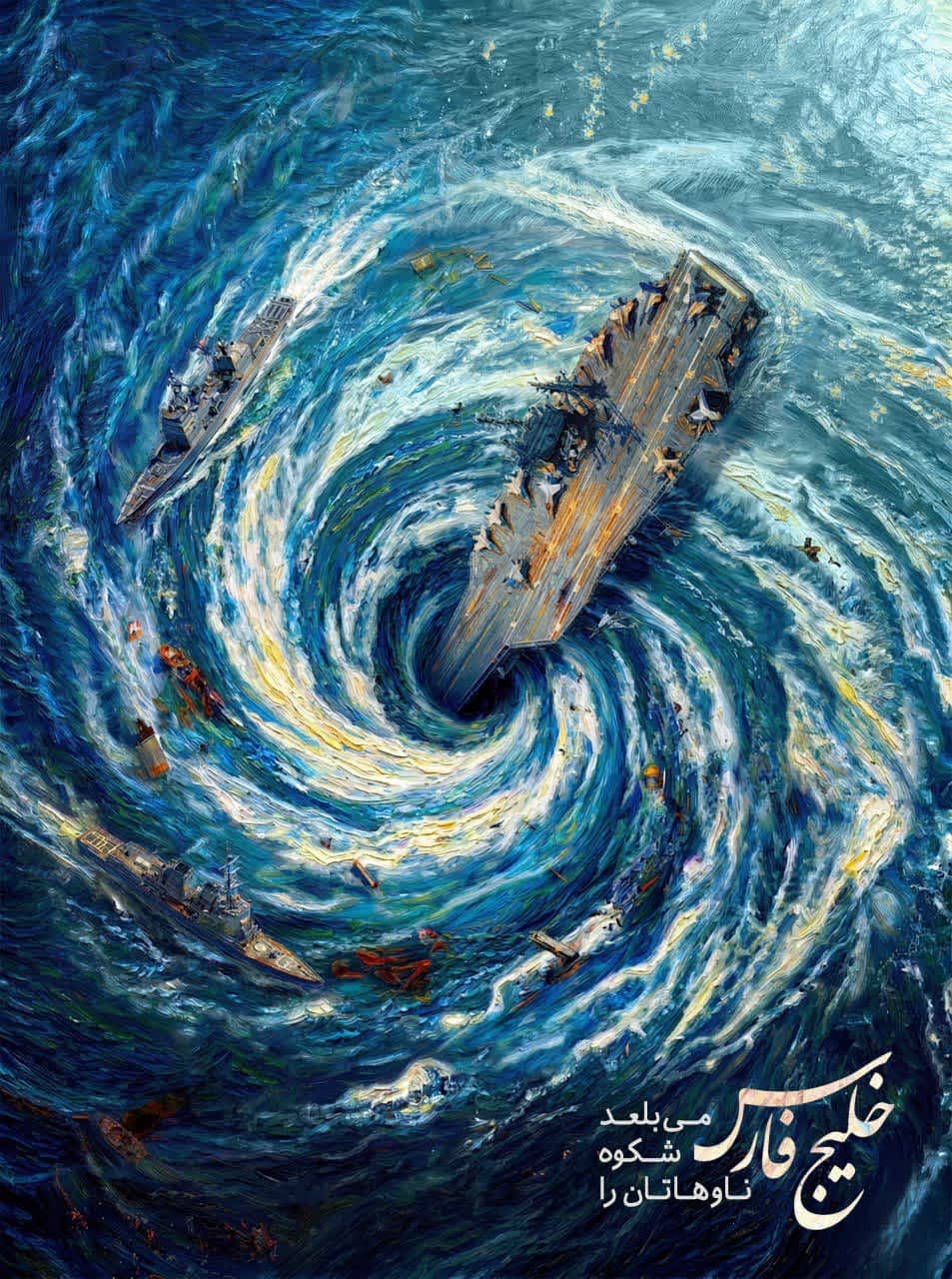
There is a statistical delta opening up in the Persian Gulf. A Bermuda Δ where oil presents and futures diverge, where public opinions and markets do not merge, where global prices do not converge, and where—as Gramsci said—“a great variety of morbid symptoms [emerge]”. Even a linguistic delta is opening up, where the dying White Empire calls it the Arabian Gulf and everybody else calls it Persian, as it was. As Gramsci didn't say, ‘the old world is dying and the new world is struggling to be born, now is the time of morons.’
The Oil Δ
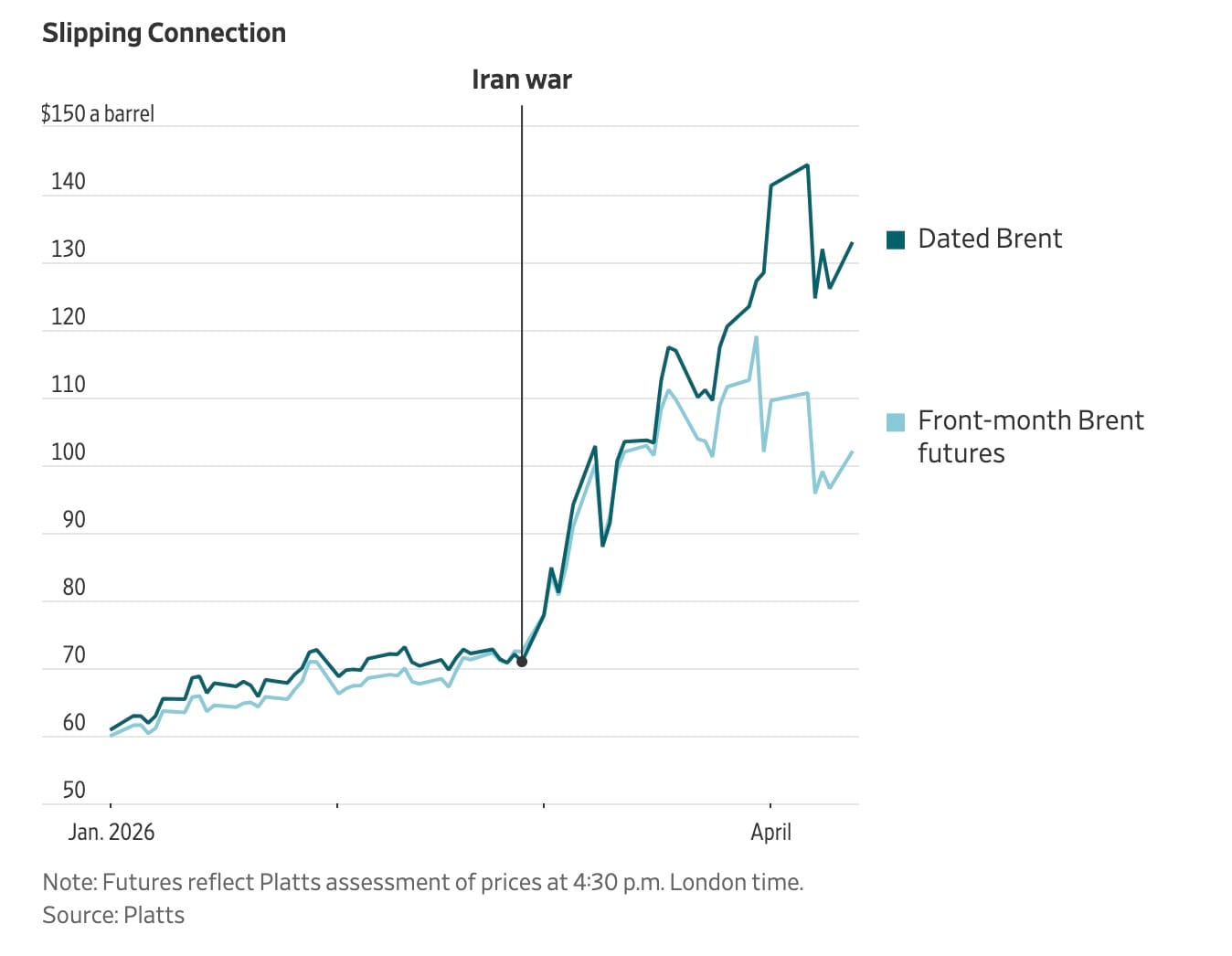
What, for example, is happening here? In an ongoing April Fool's joke, if I want to buy a physical barrel of oil (10-30 days hence) it costs $132.74. Which is a lot, I actually have running bet with a friend on this price. However, Brent Futures (2+ months hence) are trading at $99.36. The futures market is betting with him, that prices will return to ‘normal’, whatever that is.
Here's another way of looking at it, where you can see the delta rising.
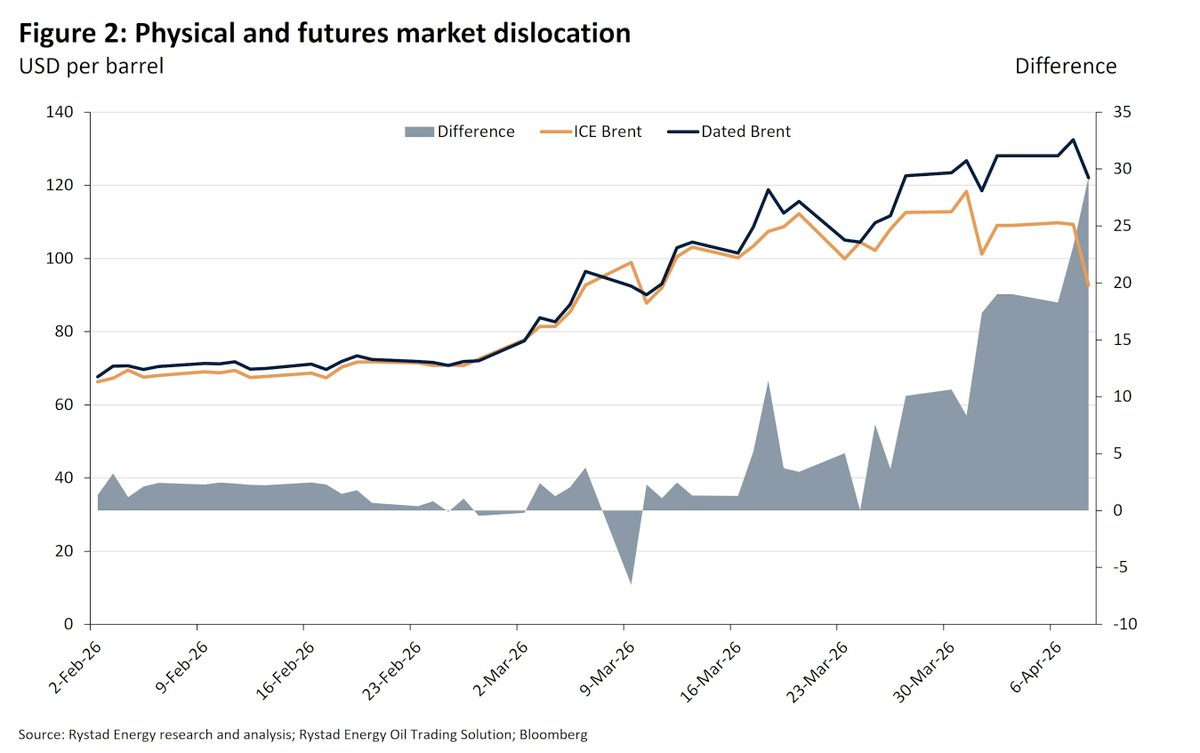
What makes this delta so weird is that we know what oil supply in 2 months will look like, it's oil production and shipments now. And these ships are stoppered out of Hormuz and on fire around the Gulf.
We also know what refined oil prices and supplies are now, in other parts of the world. As the FT reports, “Benchmark north-west European prices for jet fuel closed at $1,573 a tonne on Thursday, according to price reporting agency Argus Media, up from about $750 a tonne before the Iran war.” As the EU transport commissioner Apostolos Tzitzikostas said, “If the passage through the Strait of Hormuz does not resume in any significant and stable way within the next three weeks, systemic jet fuel shortage is set to become a reality for the EU.”
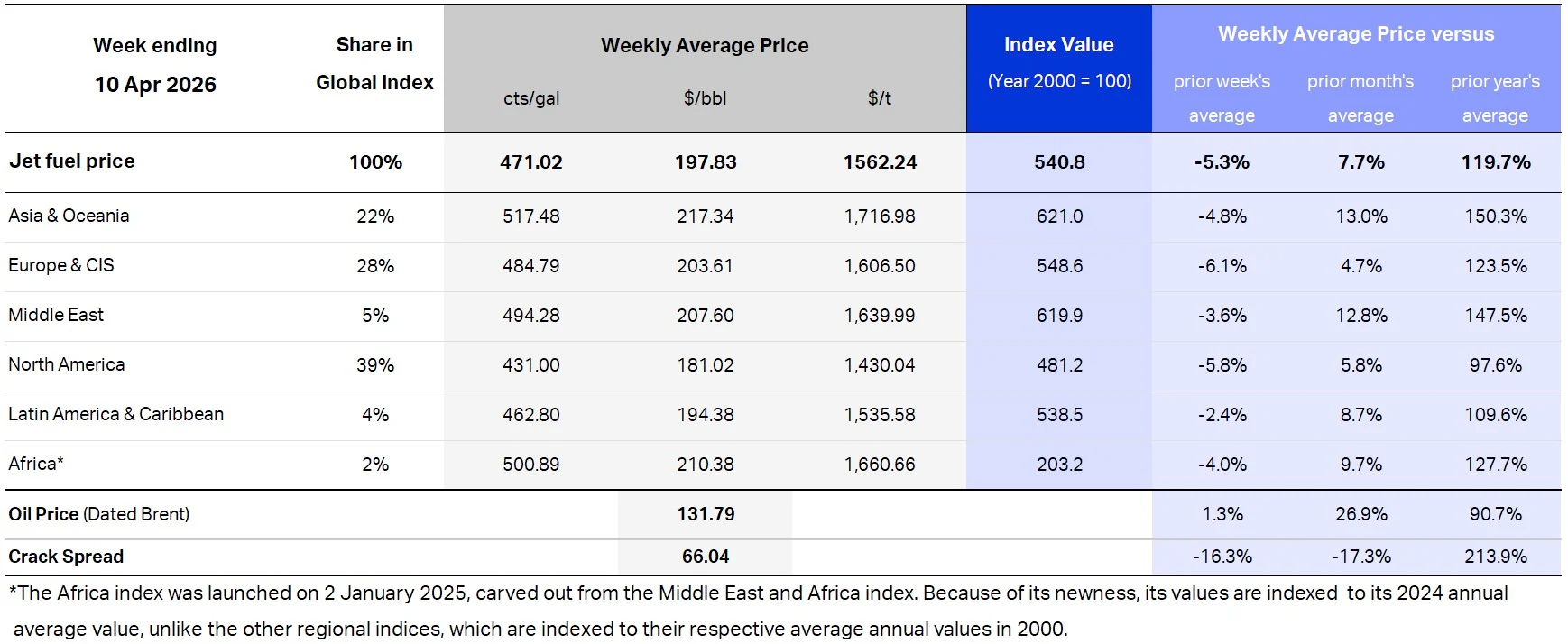
This has been the reality in Asia for a while, but I mention Europe because White people don't seem to believe in Asia as something connected to them. If you look at jet fuel prices across the world, you can see that prices are already up about 150% (from last year) in Asia and the Middle East and about 125% in Africa and Europe. Only North America is still living in last year (prices are actually 2.4% less) but oil is a liquid market and prices will slosh around until settling. As William Gibson said, the future is already here, it's just unevenly distributed.
Futures are theoretically supposed to price this future in, but they're living in the past and inverting basic supply and demand. There is less supply in the future but somehow lower prices because… magic? Trump tweets and the herd mentality moves in tandem. People are making a lot of money from this illusion now—“for example, more than $760 million worth of Brent and WTI futures changed hands about 15 minutes before Trump announced in a Truth Social post that he was postponing strikes on Iranian plants thanks to “productive” talks with Iran”—but at some point ships have to unload physical oil and it just won't be there.
Futures are “boats against the current, borne back ceaselessly into the past,” even the Great Gatsby couldn't escape that. Like boats in a whirlpool, you can think you're making great progress in some linear direction when in fact you're going in circles and down the tube. Any oil future becomes the present at some point, and then prices have to converge. As some oil dude on Twitter says, “If Dated Brent remains at $120-130/bbl leading into the expiration of the front-month ICE Brent futures contract (currently around $100/bbl), the futures contract must converge toward the physical price. The convergence is not optional; it is mathematically enforced by the exchange's settlement rules and market arbitrage.”
The jaws of this oily delta can be prised open by market and media manipulation for the carnival barker to put his head in and shout, but at some point the delta will snap shut. All the green lights will become red as reality intrudes. As F. Scott Fitzgerald wrote, in the full quote from The Great Gatsby,
And as I sat there brooding on the old, unknown world, I thought of Gatsby’s wonder when he first picked out the green light at the end of Daisy’s dock. He had come a long way to this blue lawn, and his dream must have seemed so close that he could hardly fail to grasp it. He did not know that it was already behind him, somewhere back in that vast obscurity beyond the city, where the dark fields of the republic rolled on under the night.
Gatsby believed in the green light, the orgiastic future that year by year recedes before us. It eluded us then, but that’s no matter—tomorrow we will run faster, stretch out our arms further … And one fine morning—
So we beat on, boats against the current, borne back ceaselessly into the past.
I suppose the lesson here is that if you ‘date’ oil futures long enough, you have to marry them, or get shot by their new husband, Iran.
The Spoils Δ
The promise of imperialism, even to its most impoverished denizens, were that you could get some share of the spoils. Even as public goods got worse, the 'American' poor could still get cheap consumer goods via colonies like Japan and Korea and communist economies like China.
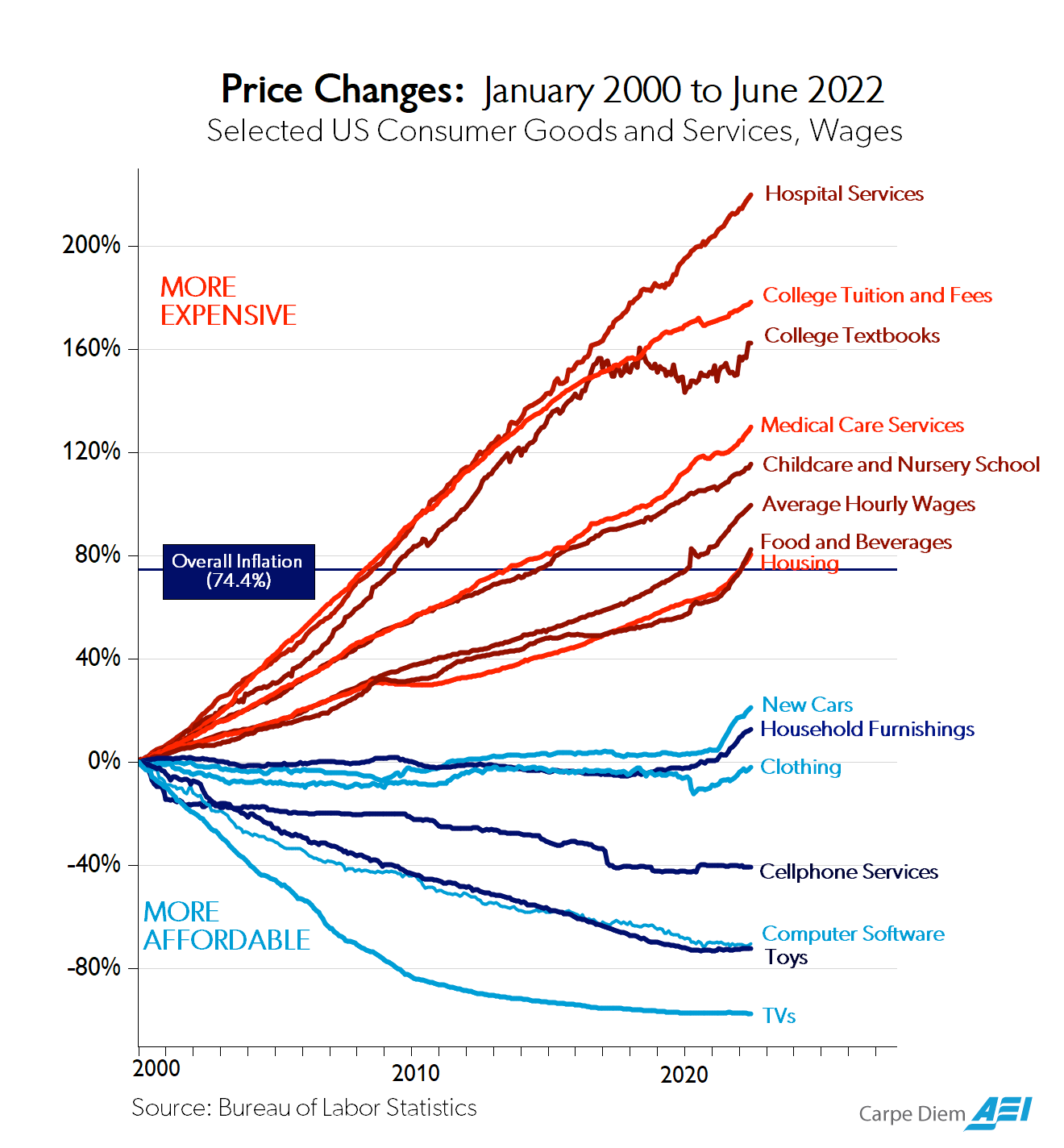
The American Enterprise Institute graphed this, though they didn't quite get it. You can see that capitalism made everything more expensive and worse (healthcare, education) while imperialism let them get the benefits of socialist production elsewhere (cheap clothing, cars, toys). This is the spoils delta that's long been opening in the heart of White Empire but people didn't feel it going rotten because their TVs got bigger every year.
The rich got richer but the poor at least got stuff. But now that stuff is going to stop coming in so cheaply, because of both tariffs and also a giant oil shock. The delta between rich and poor is going to become obvious as distractions dry up.
Now the Standard & Poor stock market index (SPX) is nearing record highs while the University of Michigan Consumer Sentiment Index (UMCSENT) has hit its greatest depression. Consumer sentiment is at the lowest level ever measured, in 70 years of this account. You can see the delta here.
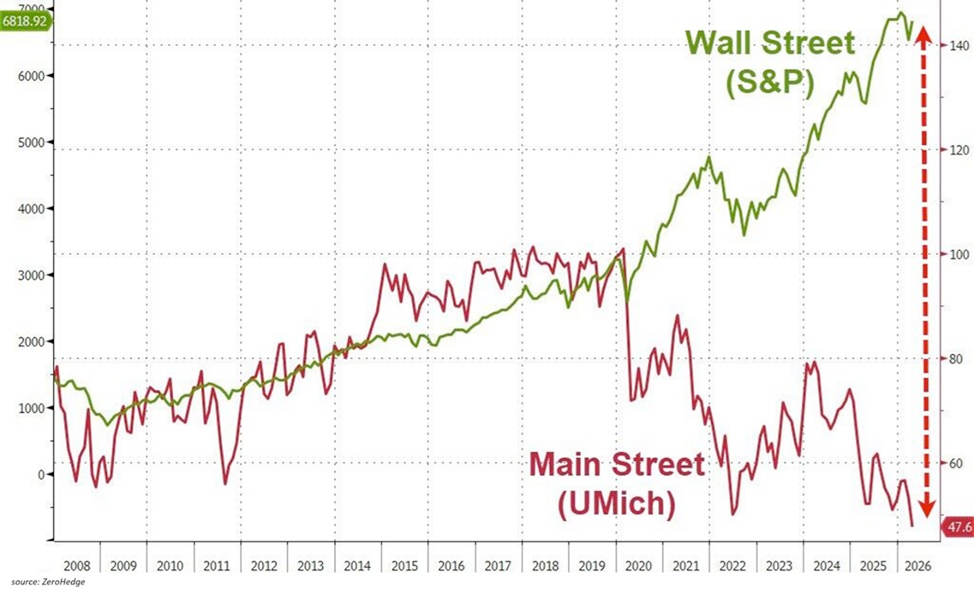
All of the price increases being caused by the attack on Iran are making rich 'Americans' even richer (remember that every price increase is someone's gain) but they are breaking the 'Mississippi' delta that kept 'America' enslaved with hydrocarbon chains. This weakens them from the inside while Iran is much more socially cohesive and can just wait.
'Americans' act like the Strait of Hormuz only affects Asia or Europe or Africa but that's your empire. That's your factory, your clothes, your gadgets, your toys, and much of your food. That was the spoils of forever war and as 'America' loses this war, they're actually losing something. A spoils delta is opening up within 'America', as the poor lose their treats.
The War Δ
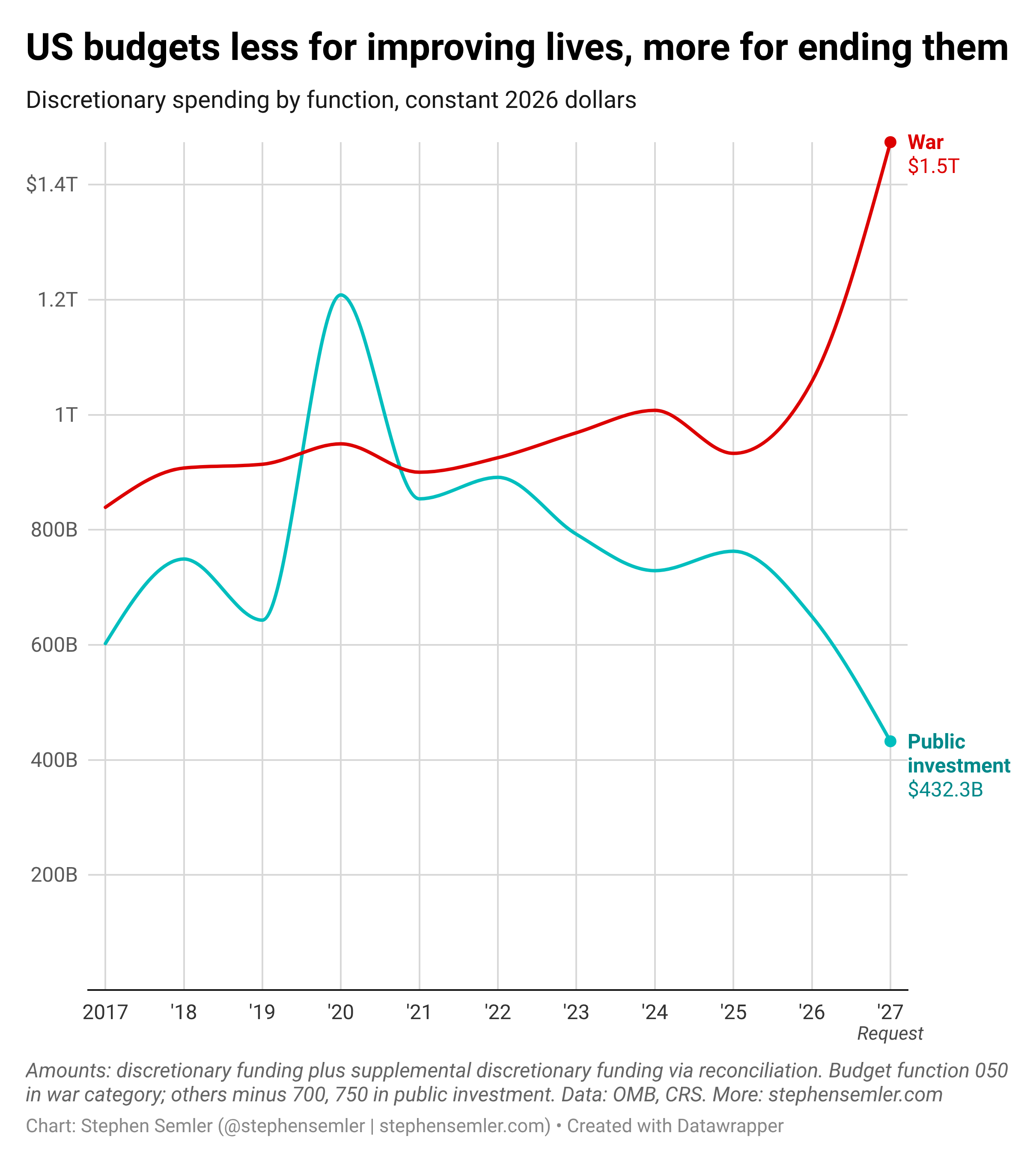
Our final chart (before I depart for three days) shows the widening delta between 'America' war 'spending' and public investment. I put war 'spending' in scare quotes because the US military budget is increasingly just corruption. Augustine's Law #16 states “In the year 2054, the entire defense budget will purchase just one tactical aircraft” and they're almost there. I honestly doubt that the union survives that long anyways.
A war that is increasingly an attack on the living standards of 'Americans' is being funded more and more while public goods for 'Americans' are being funded less and less. 'Americans' are being squeezed by a massive delta force, the cancerous growth of the military-industrial complex against the lowering life-expectancy of the body politic. 'America' is blowing up bridges which Iran can repair while bridges in Baltimore fall over and never recover. And while war might serve as a jobs program, 'America' has technology fetishized war so much that most of the money goes to fake wunderwaffen while the people are left wondering.
I don't expect 'Americans' to have a moral objection to war—'America' is war—but at some point the material concerns have to kick in. It's not just that 'Americans' are not getting material benefits from this war, what meager benefits they had are also being taken from them.
The End
Where does this end? It ends, proximately, with me going on vacation for three days because it's Sinhala/Tamil New Year, Happy Avurudu to you and your kin. But more properly, it ends when all these deltas empty into the ocean.
The contradiction between oil present and future will be resolved contractually, when prices match. The contradiction between consumer sentiments and stock markets will be resolved catastrophically, when markets crash. And the contradiction between war and public investment will be resolved psychologically, when more 'Americans' come back in body bags, and they realize that their time as head of White Empire is never coming back.
None of this happens automatically, this widening delta was wrenched open by resistance in the Persian Gulf, and in Palestine before it, by the death and ongoing struggle of millions. But now the Al Aqsa Flood they started cannot be rolled back, and all the tweets and market motions are just the waves on a rising ocean. As Gramsci said in the more full quote from above,
That aspect of the modern crisis which is bemoaned as a "wave of materialism" is related to what is called the "crisis of authority". If the ruling class has lost its consensus, i.e. is no longer "leading" but only "dominant", exercising coercive force alone, this means precisely that the great masses have become detached from their traditional ideologies, and no longer believe what they used to believe previously, etc. The crisis consists precisely in the fact that the old is dying and the new cannot be born; in this interregnum a great variety of morbid symptoms appear.
The wave of materialism started by Al-Sinwar in Gaza has turned into a flood that blocks the Strait of Hormuz and its consequences have already changed the world. Markets are trying to keep the simulation going a little longer, but they cannot. The old is dying and the new, now, can be born. People already believe something different across Asia and are acting on it. And all the great markets, masses, and militaries of the past will have to react to them now.