3 Basic Facts of (Ramadan) War
There are a few basic facts about war which seem to be ignored by the most warlike people in history.
- Defense > Offense
- High Ground > Low Ground
- Infantry > Everything Else
Broadly speaking, you would not attack a mountain fortress with no infantry and expect to conquer it, but this is exactly what the White Empire is doing in Iran, and with zero planning. We talk specifically how this is bad all the time, but now let's talk generally, how it's bad from first principles.
First, Principles
1 | Defense > Offense
“As we shall show, defense is a stronger form of fighting than attack”
Carl von Clausewitz, On War
The simplest wargame, RISK, has only one rule for combat. Both sides roll dice, and the defender wins a tie. In RISK you can ‘load’ the dice by invading with more armies, giving you three dice to the defender's two, but the basic principle is true for real war too. A tie goes to the home side. Why? As Clausewitz said,
What is the object of defense? Preservation. It is easier to hold ground than take it. It follows that defense is easier than attack, assuming both sides have equal means. Just what is it that makes preservation and protection so much easier? It is the fact that time which is allowed to pass unused accumulates to the credit of the defender.
Defense also allows you to accumulate another advantage, terrain, which the defender can live off, escape into, and use to their advantage. As Clausewitz also said, “In strategy as well as in tactics, the defense enjoys the advantage of terrain, while the attack has the advantage of initiative.” This is not to say that defender are always unassailable, but in RISK as in war, you need to go in with overwhelming force to assail them.
Of course, America has long gone into wars with unequal means which they procure through not so much manpower as horsepower, cavalry for lack of a better word. But what Clausewitz said about that still holds true in the long term. He said, “An army consisting simply of cavalry is conceivable, but would have little strength in depth.” America has 'conquered' many countries in my lifetime, but held none of them. Because even the weakest opponent has the advantage of time, which accrues to the defender.
As Ho Chi Minh said, “the Vietnamese people, armed only with pointed bamboo sticks, had to start a long and heroic war of resistance against the French colonialist aggressors aided by the US imperialists.” And they did it, though it took decades. After the war, an American general said, “You never beat us once.” To which the Vietnamese General responded, “True, but irrelevant.” Given enough time, defense always wins a tie. Or as that war criminal Henry Kissinger said, “the guerrilla wins if he does not lose. The conventional army loses if it does not win.”
2 | High Ground > Low Ground
“In general, an army prefers high ground and dislikes the low ground.”
Sun Tzu, The Art Of War
The simplest war—dudes running at each other with sticks and stones—shows the power of high ground. Dudes can see further on top of a hill, and sticks and stones go further. You can also see this in the children's game King of the Hill, which I assume has been cancelled by now. When we used to play it, one kid could hold off many simply because it's easier to push downhill. Whereas defending gives you the advantage of time, high ground gives you the advantage of gravity.
We are so used to watching war in 2D that we forget this power of terrain, but if anything, the effect is more pronounced in modern warfare. Satellite overview provides the ultimate high ground. Airborne planes and land-based radar let you 'see' further, but real mountains can still confound these things. When Americans talk about air superiority, this is really what they mean. It means taking the high ground and fighting down from it, with all the advantages that brings.
The only response to the enduring power of high ground has been going completely underground. As Master Sun said, effectively predicting the Gaza War, “To excel at defense means hiding oneself away in the deepest recesses of the earth. To excel at offense means striking from the highest reaches of the heavens.” Again, all of these basics of war can be complicated to your advantage, but you have to at least think about them. As Sun Tzu said,
Now, the one who has the most tallies in the “temple calculations” before battle will surely be victorious over the one with fewer, let alone the one who has no tallies at all! From this I conclude that victory and defeat can be foreseen.
3 | Infantry > Everything Else
“In recent wars the major role has undoubtedly been played by the destructive power of firearms: but it is no less clear that the true, the actual core of an engagement lies in the personal combat of man against man.”
Carl von Clausewitz, On War
If artillery is the god of war, and cavalry its angels, they still need men to believe. If you want to wage war, you still need infantry, because as Logan said in Succession, “Life's not knights on horseback. It's a number on a piece of paper. It's a fight for a knife in the mud.” You can destroy countries from afar, you can corrupt compradors, but when it comes to real war, you've got to put real men and spill real blood.
Despite all the technology, warfare hasn't changed that much from Alexander marching all over. You still have to show up. As Clausewitz said,
An army composed simply of artillery, therefore, would be absurd in war. An army consisting simply of cavalry is conceivable, but would have little strength in depth. An army consisting simply of infantry is not only conceivable, but would be a great deal stronger. The degree of independence of the three branches, then, is infantry, cavalry, artillery.
American war is an absurdity in this sense, it's basically cavalry delivering artillery from afar. Clausewitz said such a structure would be A) absurd and B) have little strength in depth, which basically describes America. America is able to topple many governments, but unable to conquer anywhere. Clausewitz's very basic principles predict this, when he says “it [artillery] must always be covered by infantry, since in itself it is unable to engage in hand-to-hand combat. If there is too much artillery, and the troops detailed to cover it are in consequence not strong enough at every point to beat off the enemy, guns are easily lost.” You can see the results in Afghanistan, which they occupied for decades, but then fled, losing much of their armor.
Stalin said artillery was the god of war (in World War II), and America elevated its Satanic cavalry to deliver it from afar, but in the end you still need men on the ground who believe to have any earthly power.
Second, Application
Now that we've done some theory, which I recommend you read directly (the Michael Nylan translation of Art of War is good and Clausewitz is Clausewitz, check Anna's Archive) let's look at what these basic principles mean for the Ramadan War, Iran vs. the White Empire.
1 | Defense of Iran
Iran is defending in this case. They were attacked first, they were attacked before, and they are well-prepared and dug-in for generations. And Iran is not Ho Chi Minh's Vietnam, where resistance had to start with bamboo sticks and an illiterate population (which the communists quickly increased to 95% literacy). Iran is a more scientific society than America with more sophisticated weapons and a much more popular government. The normal American defeat, which takes years or decades, is now being compressed into months or weeks, because Iran is not the usual natives they're used to dealing with. But the principle remains the same, that time accrues to the defender. It's just the velocity that changes. This is one of those weeks where centuries happen.
Because they're defending their own land, Iranians are highly motivated. And, since they've been sanctioned for decades already, they're quite capable of living off the land, and even prospering in isolation. Iran is also not Ukraine, spending as much time begging as bombing. They have their own indigenous weapons systems and open supply lines to China and Russia for resources and a few supplementals (like satellite intelligence). Americans talk about Iranian missiles running out, but that's just them accufessing again. America is running out and their supply lines stretch across continents and across enemy lines (China), but Iran's stuff is cheap they're in their own land, with access to their own resources, and Asia if they want it. It's no contest.
Brig. Gen. Jabbari has said Iran can fight for 10 years like this
Iran also has the advantage of terrain, which we'll discuss in more detail. The country is a natural fortress. Iran can really fight for decades while the invaders have to refuel in the air and get blown out of their hotel rooms, surrounded by people that hate them. The most powerful advantage of defense is that time is on your side, and Iran doesn't even need that much time, and their terrain is unassailable. Just look.
2 | The High Ground Is Iran
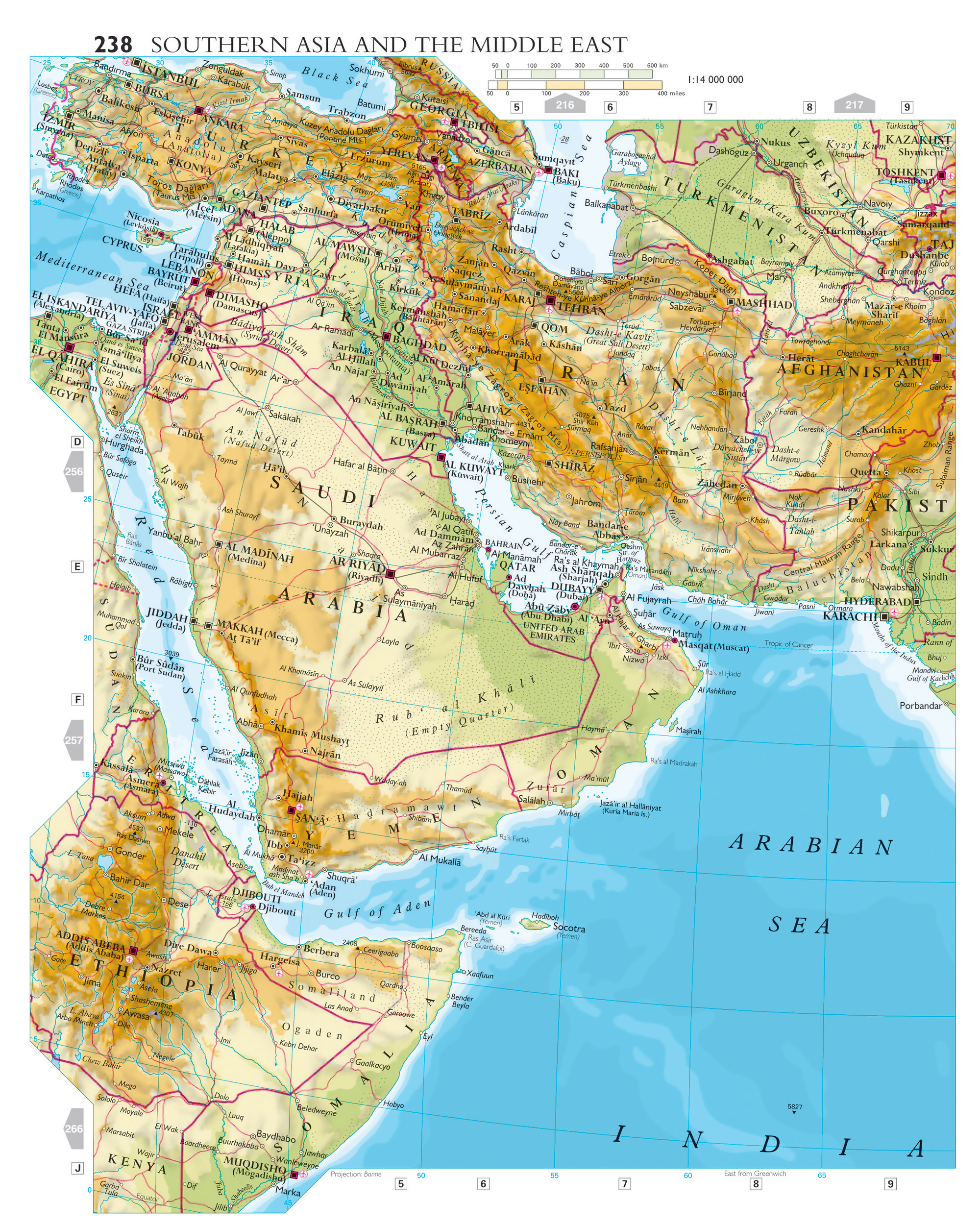
If you look at the Middle East (to me, West Asia is Europe), the high ground is Iran. Iran can hide in the mountains and fire down while their enemy is spread on a great plain before them, like a buffet of morons. Iran is not Iraq, where America could roll in from the south. Just ask Saddam, who tried for eight years with American help and got nothing but betrayed for his troubles. Again, just look at a map. Where do you even land an expeditionary force? At the foot of the mountains? You'll just get kicked off.
Then look at the White Empire's relative positioning, all the United Arab Eunuchs it cucked. All of their main bases are at sea-level, across an open firing range called the Persian Gulf. And just look at those bases now (in Bahrain, Qatar, and the UAE). They're under constant fire, they're on fire, and all the radars were actually for defending 'Israel'. They were useless at such short range and have returned to rare earths.
Now stretching in front of Iran is an unprotected plain, all the way from the river to the sea, except the river is the Euphrates. America (and 'Israel') can try to protect this with planes, but those are just temporary high ground, which must return to park. Where Iran can reduce them to smoldering hulks, or just take out their refuelers, which are even easier. They've taken out at least 7 of the latter already. With the radars down, it's as easy as rolling rocks down a hill, and they have plenty of rocks. Now Iran is methodically trashing the bases in Saudi Arabia and Jordan and 'Israel'. It's just a matter of gravity, and time, which are both on their side. Iran has the moral, technological, and physical high ground, and there's no coming back from that. It's like playing King of the Hill with the preacher's son who also has a rocket-launcher. There's nothing for it, the American have to beat it or eat dirt.
3 | Infantry Smothered In The Crib
Now let's get to infantry, which America is never getting to. Which means they're never getting what they want. America's stated goals—regime change, stealing nuclear material and oil, Balkanizing the country—are impossible without ground forces, and but even touching the soil of Iran is impossible for them. It's a non-starter, because their infantry game is retarded, and also because Iran is a fortress.
America has not been able to properly mobilize since Vietnam, and this current army is just people depraved enough to sign up after Iraq. Given that Iran has at least 600,000 troops and 350,000 reserves, they would need really double that for a serious invasion, and America has no population to draw on and nowhere to put them. Just at the bottom of some mountains where more rockets will roll over them. America is literally just counting on aerial terrorism to provoke a rebellion inside Iran, but even the Kurds aren't falling for that anymore. And it just riles the Iranians up to fight harder. As Sun Tzu said,
Do not attack an enemy who has the high ground.
Do not go against an enemy that has his back to a hill.
Do not follow an enemy that feigns retreat.
Do not attack the enemy’s crack troops.
Do not take the enemy’s bait.
Do not stop an army on its way home.
When surrounding the enemy, leave him a way out.
Do not press an enemy who feels cornered.
These are the rules for deploying troops.
The Art of War is of course lost on these people, all we've got is The Shart of War from Donald Trump. The latest plan—if you can count tweets from a boneheaded bonespurred charlatan as a plan—is to send thousands of Marines to die on an island, not even the mainland. These troops likely wouldn't even see an Iranian soldier, just missiles and drones until they're dead.
America wants Iran to lick its boots without putting boots on the ground. It's impossible. As Clausewitz said, “the actual core of an engagement lies in the personal combat of man against man” and America just doesn't have the fight in them. Just look at the Ramadan War. Their infantry hasn't even showed up yet, and never will. All they have is a bunch of conscript Jews, who are even more useless. That's what I say Iran has strategically won already. America hasn't even showed up, they lose by forfeit.
Back To Basics
I dwell on the theory not because it's hard but because it's simple. Any street fighter knows that you don't run up in someone else's hood unless you've got serious back up. Any child knows that you don't fight someone on top of a hill who has a lot of rocks. And everyone knows that you can't ask for much if you don't show up. This is not sophisticated Art of War stuff, unless you consider that such texts were written for aristocratic failsons that lacked common sense and needed such things explained to them.
Iran is of course doing many sophisticated, fascinating things, from inventing loitering defensive drones to manipulating the whole global economy to supporting freedom forces around the region, creating even more points to put the squeeze in. But before that, they have gotten the basics right while their opponents immediately lost their bases and debased themselves. The Americans are fingerpainting in blood while Iran is writing calligraphy on the tombstone of White Empire.